Last updated October 30, 2026
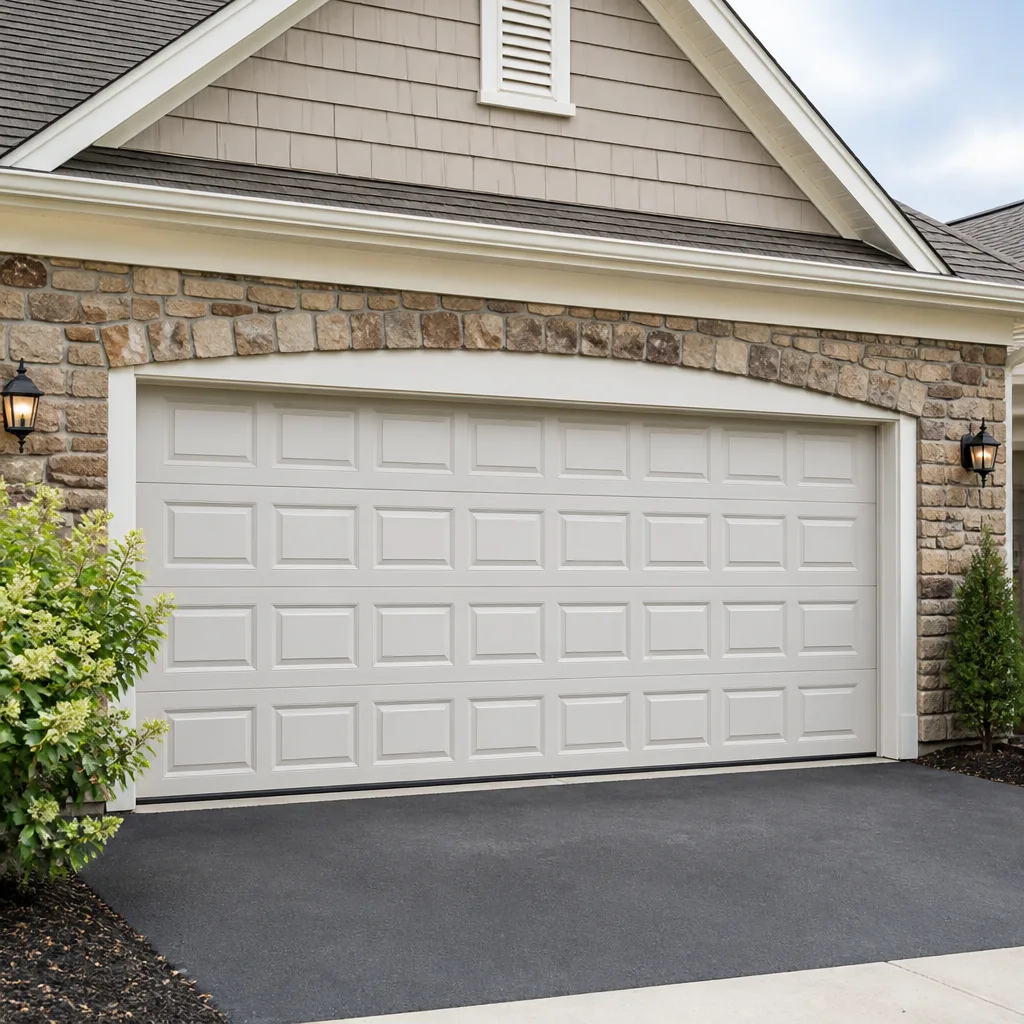 Raised-panel steel
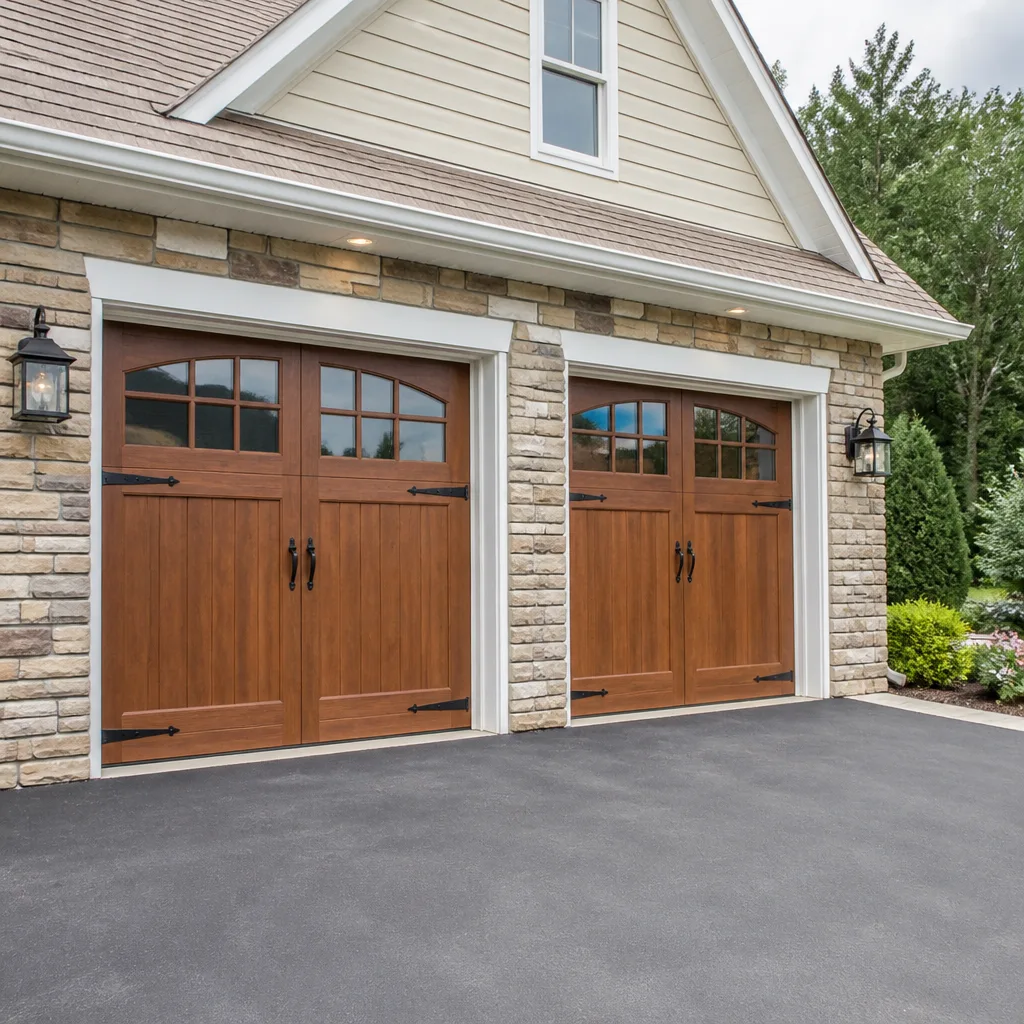 Carriage house
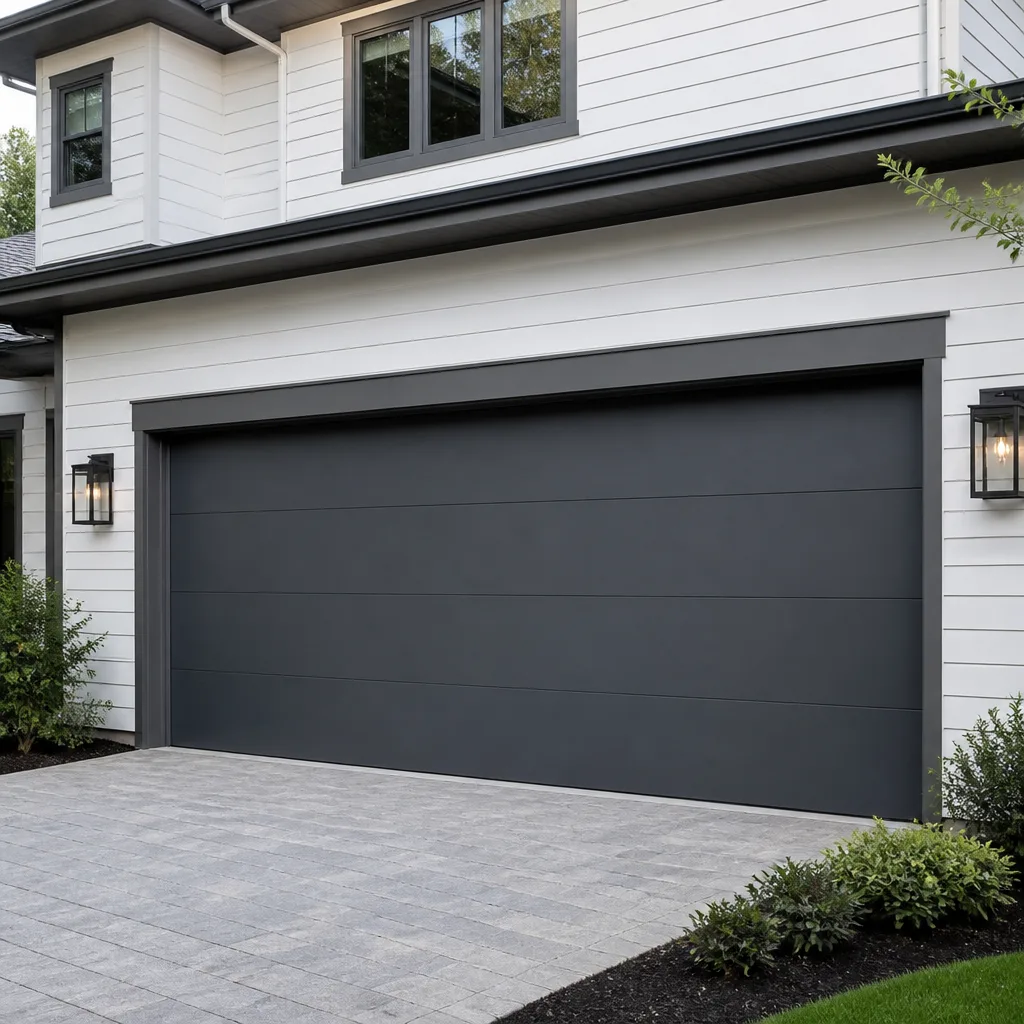 Modern flush
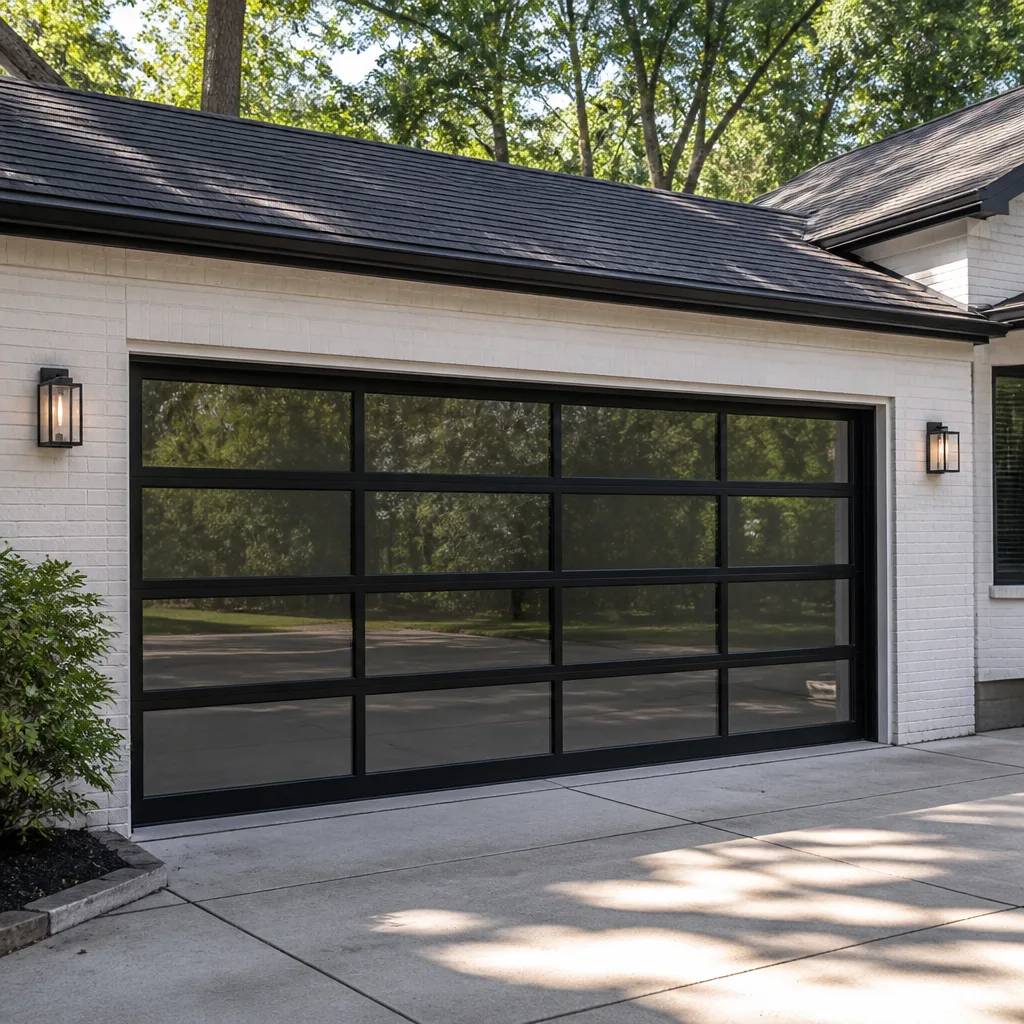 Full-view glass
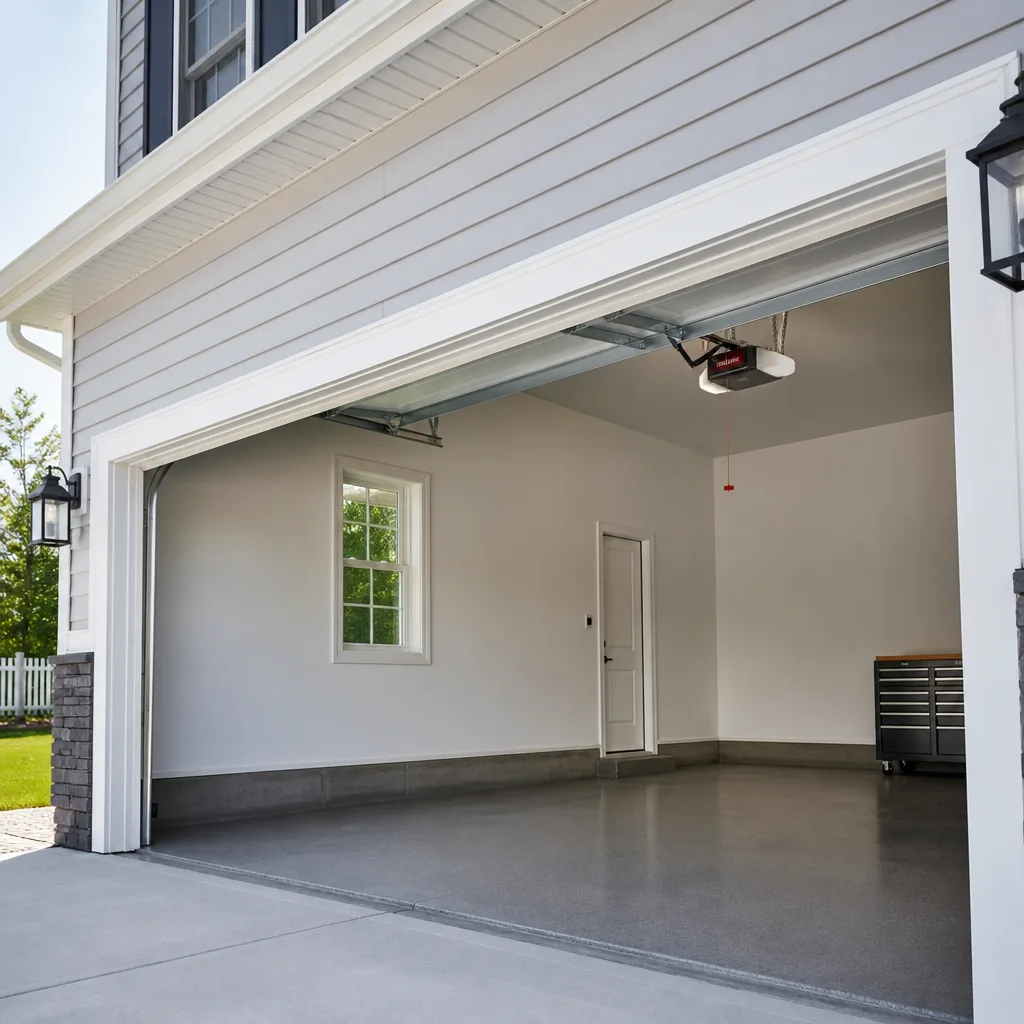 LiftMaster openers
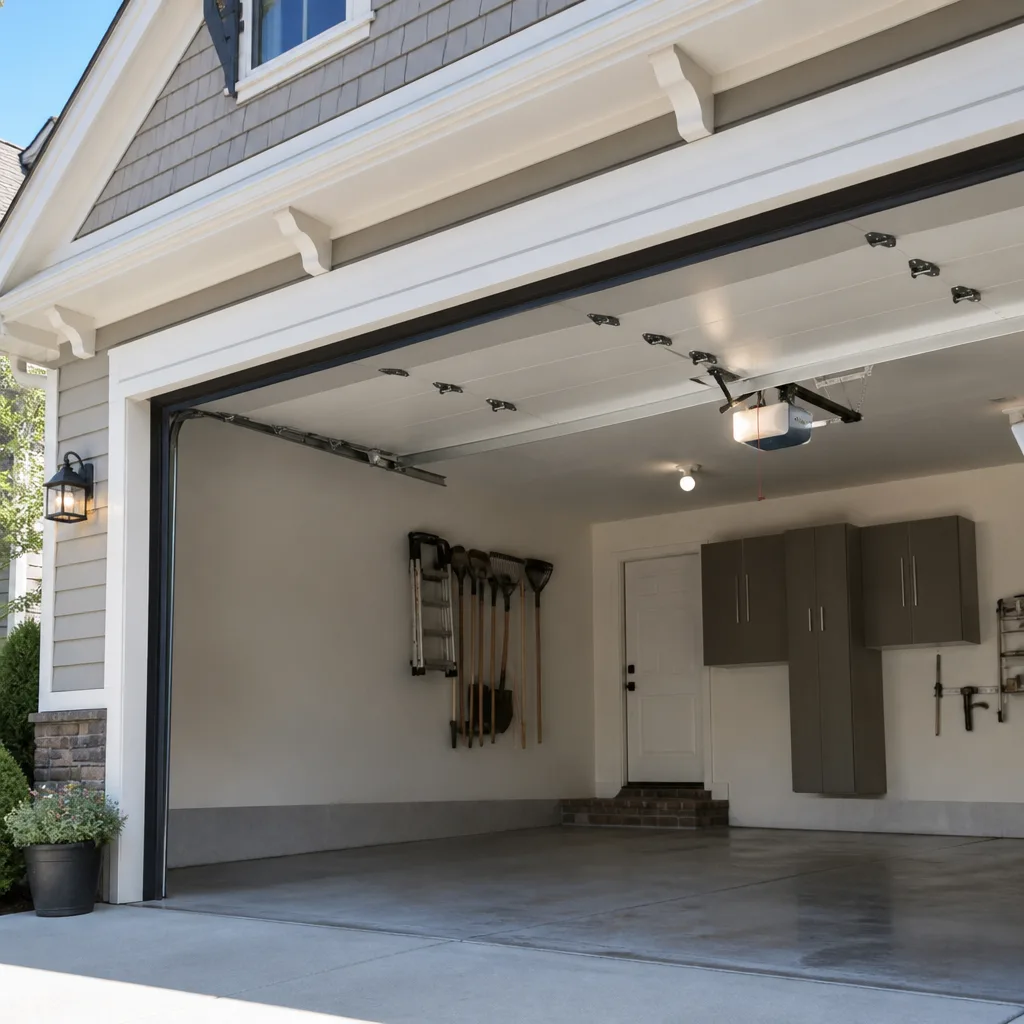 Chamberlain openers
Full 25-point door and opener safety check with every visit - springs, cables, rollers, tracks, and your LiftMaster or Chamberlain opener included
You get a price before we start. It does not change when the truck arrives.
Get your free estimateThe Complete Guide to Garage Door in Santa Ana
Most garage door breakdowns in Santa Ana don’t start with the part that finally snaps. In the tracts of 1970s through 1990s construction that dominate this city, the majority of service calls we run trace back to the same three overlooked components: torsion springs that have quietly exceeded their cycle rating, cables fraying inside the drum assembly where nobody looks, and mounting brackets that have worked loose against aging stucco. What you hear is the loud failure. What broke is something that was warning you for months. This guide walks through the entire system as it actually exists in Santa Ana homes, what fails first, what those failures cost, and when to fix versus replace. By the end, you’ll read a service quote the way a technician does.
Styles & brands we work with
Quick Answer
The complete guide to garage door in Santa Ana means understanding a system with five failure points: springs, cables, rollers, tracks, and the opener drive. In Santa Ana’s housing stock specifically, the most common service call is a torsion spring break on a 25 to 40 year old door that has outlived its rated cycle count. The second most common is an opener from the early 2000s whose logic board or gears have finally given out. The right fix depends on the age of the door, the brand of the opener, and whether the failure is isolated or systemic. Most repairs in Santa Ana run between $150 and $450 depending on the component, and that price is quoted and agreed before any work starts.
Table of Contents
- Why Santa Ana’s Housing Stock Dictates What Breaks
- The Full System Map: What Each Part Does and How It Fails
- Why Santa Ana Air Corrodes Garage Hardware Faster Than You’d Expect
- The Brand Landscape Actually Present in Santa Ana Homes
- How to Read a Garage Door Service Quote
- Repair vs. Replace: The Real Decision Criteria
- What You Can Safely Check Yourself, and What You Shouldn’t Touch
- Common Mistakes to Avoid
- When to Call a Professional
- Frequently Asked Questions
Why Santa Ana’s Housing Stock Dictates What Breaks
Santa Ana’s residential footprint was largely built out between roughly 1955 and 1990, with dense tracts of single-family homes concentrated in the Washington Square, Morrison Park, Floral Park, and Heninger Park neighborhoods. What that means for garage doors is very specific. Unlike the newer master-planned communities in south Orange County, many Santa Ana homes still carry their original garage door hardware or, at best, a second-generation replacement installed 15 to 20 years ago. The doors on these homes are predominantly 16-foot-wide sectional steel doors, single torsion spring configurations, and chain-drive openers from the early 2000s or earlier.
We see this pattern constantly. A homeowner in the Washington Square tract reports that the door “suddenly won’t open.” What actually happened is that the torsion spring, rated for 10,000 cycles, has been in service since 1987. At roughly four open-close cycles per day, that spring hit its engineered cycle limit around 1994. It has been running on borrowed time for three decades. The break wasn’t sudden, it was scheduled. The mounting brackets that held it in place have been slowly wallowing out their lag holes in dry, aged framing. The cable that snapped was rusting inside the drum because that garage has never been ventilated.
Here’s the pattern we see across Santa Ana’s older tracts:
- Original doors from 1970-1990: Still common in Washington Square, Heninger Park, and Morrison Park. The panels are thin-gauge steel, the rollers are often worn to the point of wobbling in the track, and the springs are long past their cycle rating.
- Second-generation doors from 1995-2010: Often a mix of brands. The door might be a Clopay installed in the early 2000s, but the opener is a LiftMaster from the 1990s that has outlived two belt replacements.
- Opener age is the silent variable: We frequently see Wayne Dalton door hardware paired with a Craftsman opener manufactured in 1998. The door is serviceable. The opener is the problem.
The practical takeaway: if your Santa Ana home still has original 1980s hardware, the door wasn’t built to last 40 years without major component replacement. The springs, cables, and rollers were designed for a service life of roughly 10 to 15 years under normal use. When we diagnose a failure, we look at the whole system’s age, not just the part that broke. This is the difference between a repair that holds and a repair that fails again in six months. Our Garage Door Repair in Santa Ana work starts with that full-system assessment, not just a part swap.
The Full System Map: What Each Part Does and How It Fails
A garage door is not one machine. It’s a counterbalanced system with five critical component groups, plus the opener that automates it. When one component degrades, it transfers load to the others. Failures cascade. Here’s each part, what it does, and how it fails in the specific conditions of Santa Ana garages.
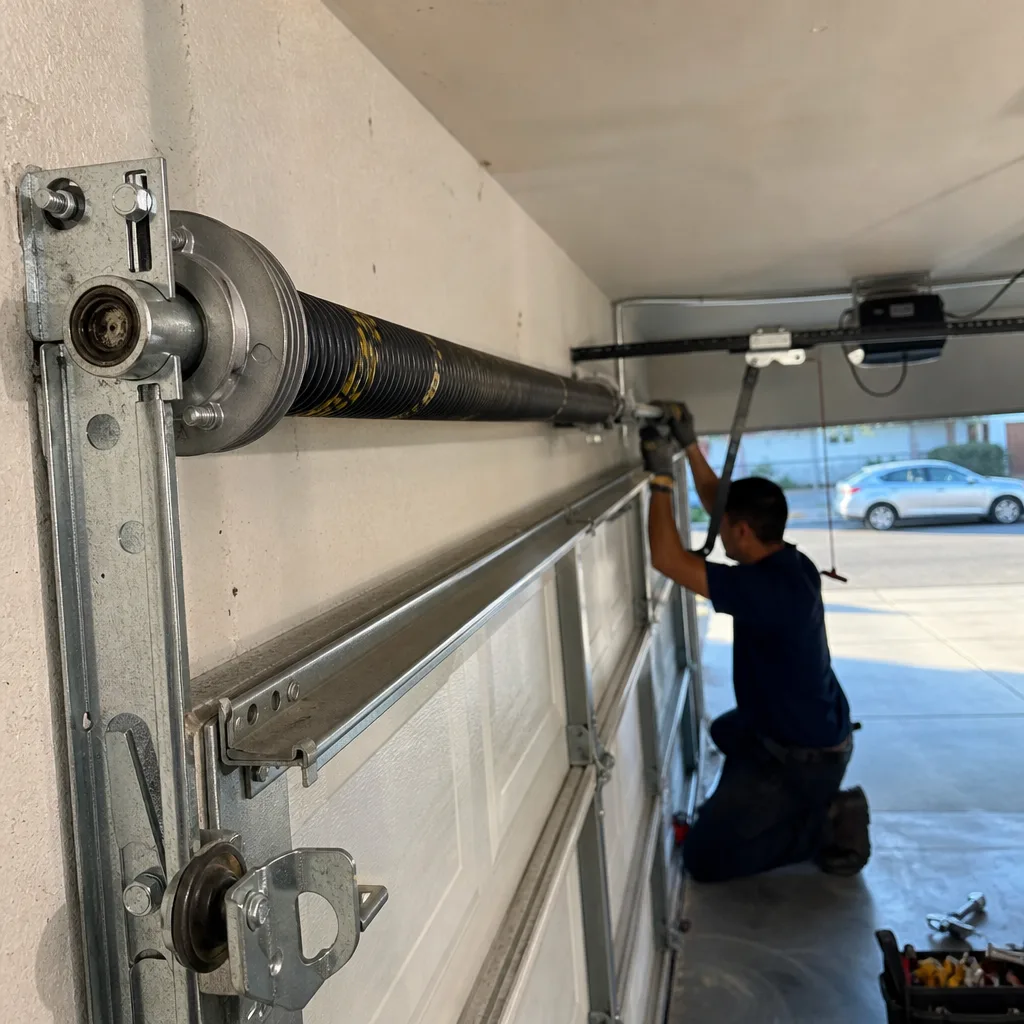
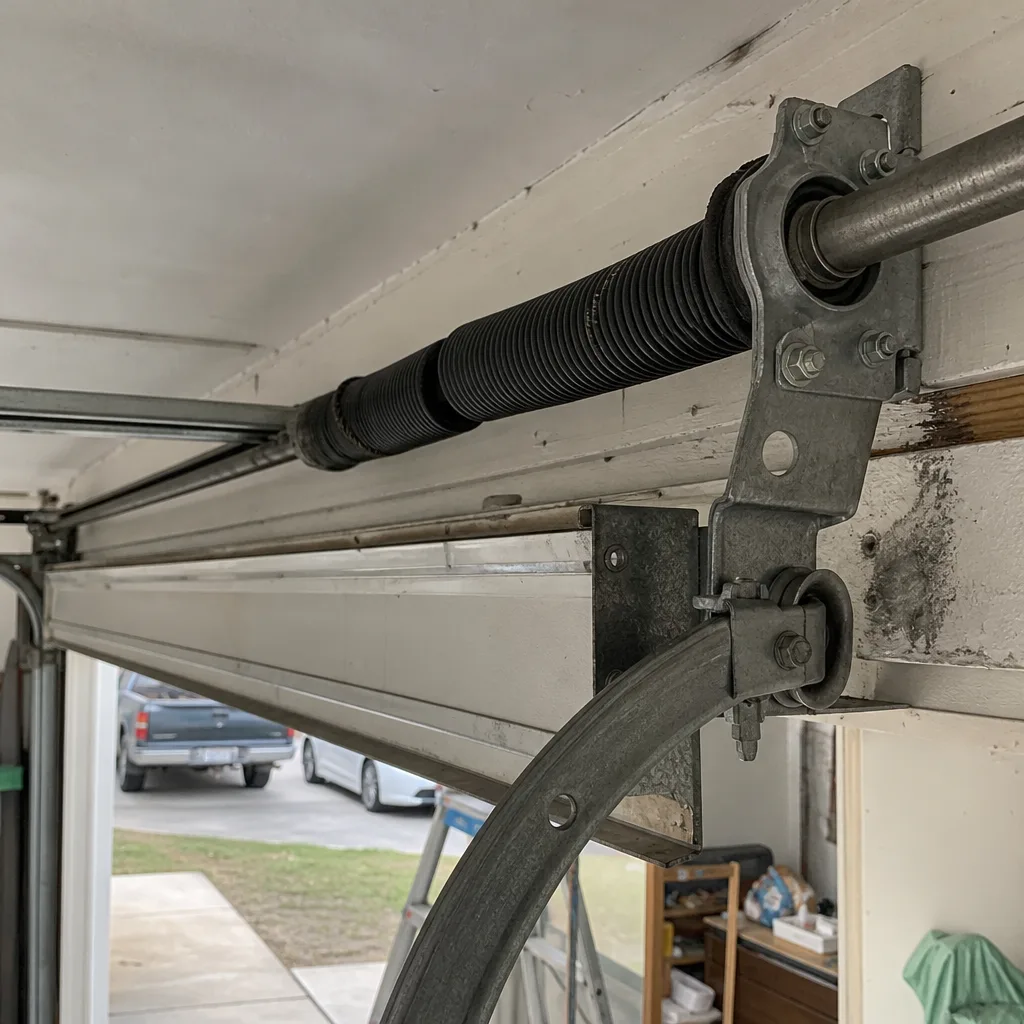
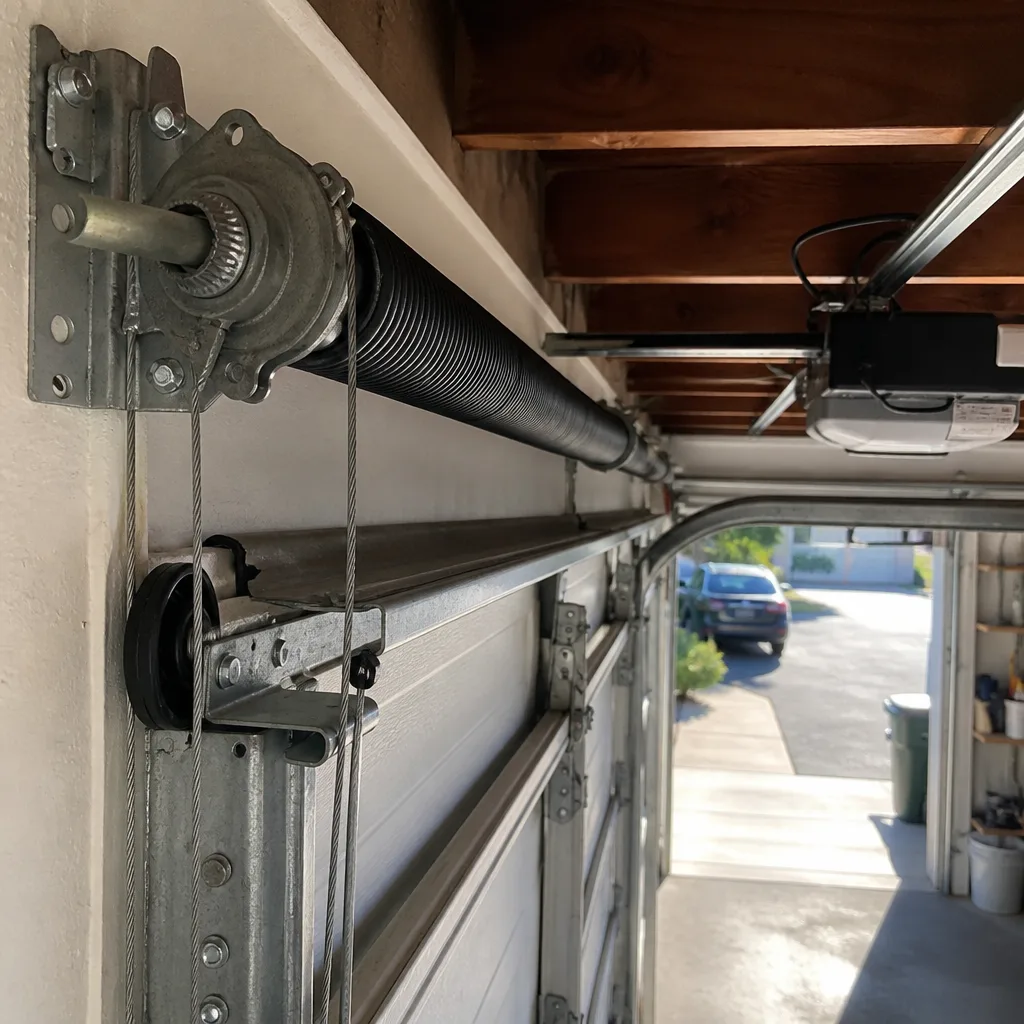
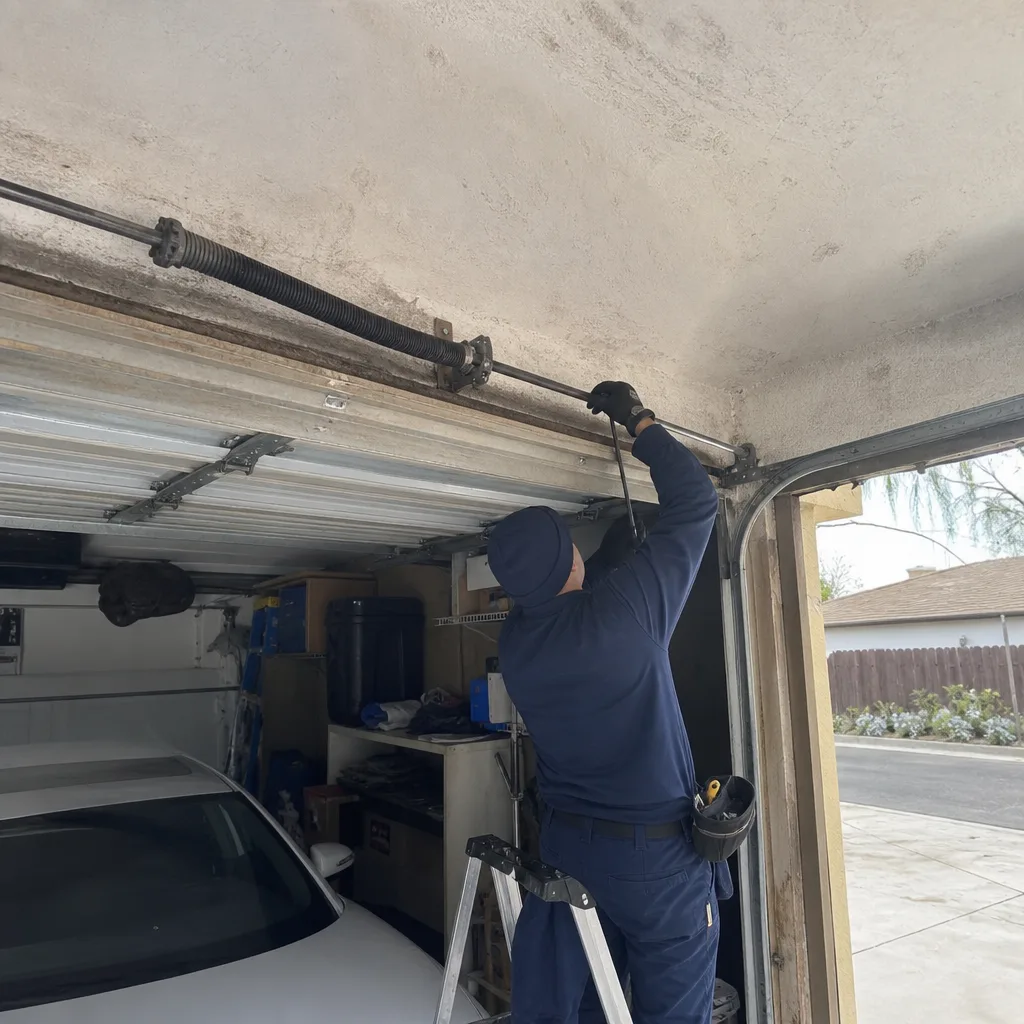
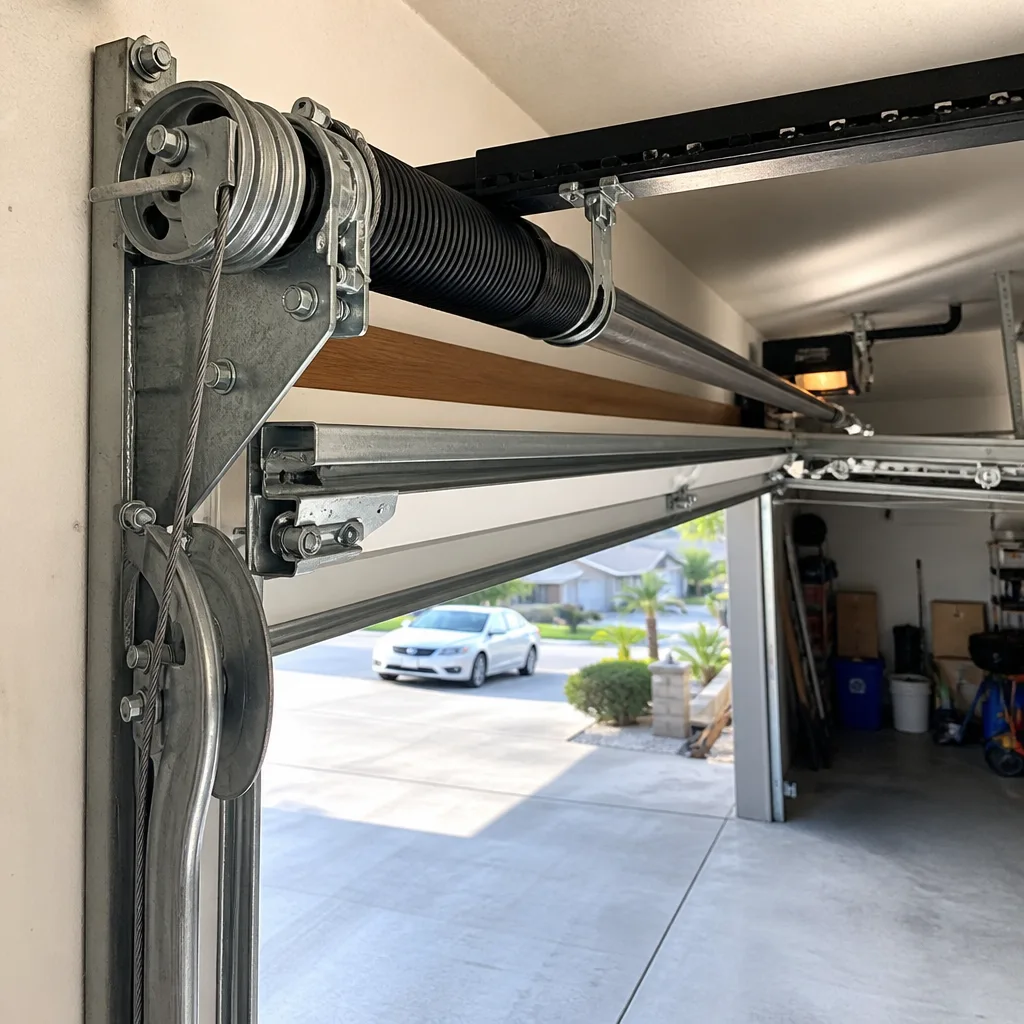
The Torsion Spring System
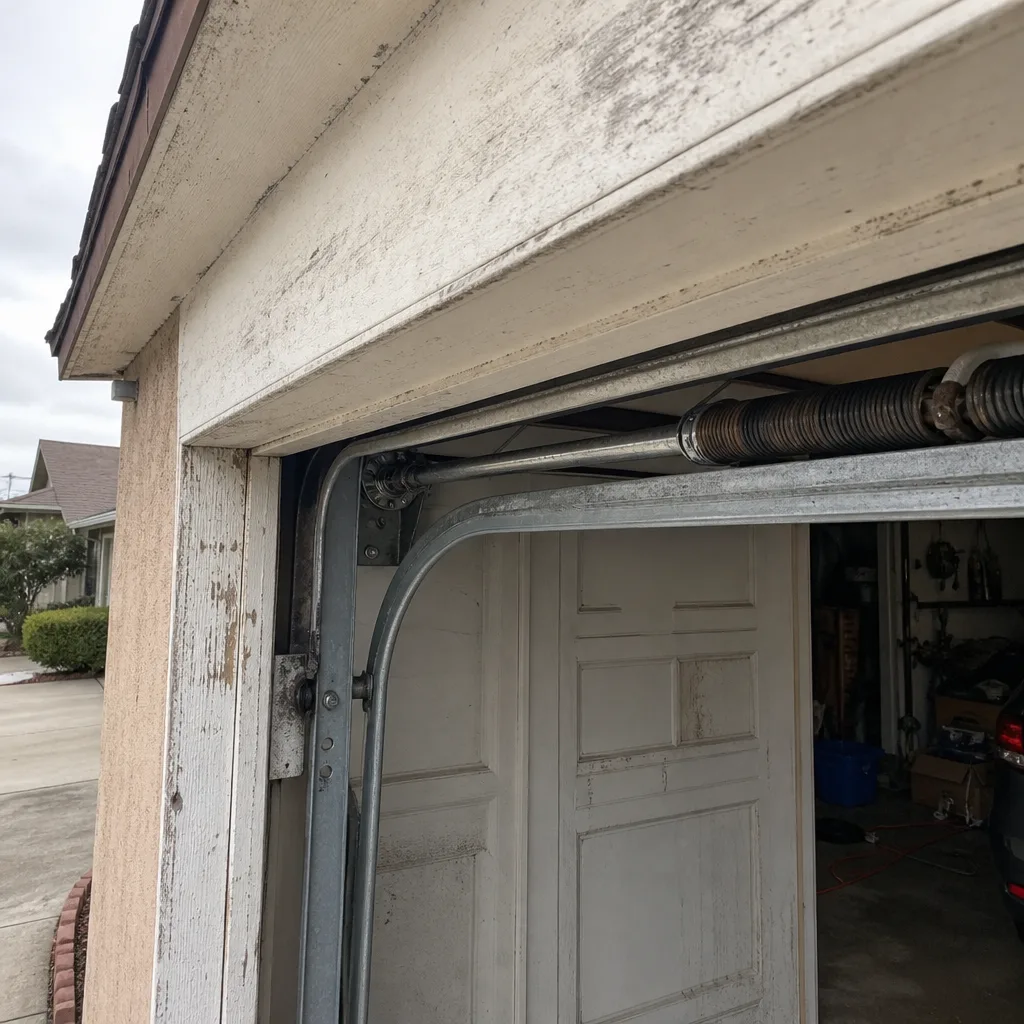
The torsion spring assembly sits on a metal shaft above the closed door. Its job is to store the energy needed to lift the door’s weight, which on a standard 16-foot Santa Ana sectional door runs between 150 and 250 pounds depending on gauge and insulation. A spring is rated in cycles: one full open and close equals one cycle. Standard springs are rated for 10,000 cycles. That’s roughly seven years of normal daily use. Higher-cycle springs, rated 25,000 or more, are what manufacturers install on newer doors. In a Santa Ana home built in the 1980s, if the spring is original, it’s empty. It has been empty for decades. When it breaks, it sounds like a gunshot in the garage. Do not attempt to manually lift a door with a broken spring. The door is now a dead weight of roughly 200 pounds. Call a professional.
Cables and Drums
Cables run from the bottom brackets of the door up to the drums on each end of the torsion shaft. When the spring winds, the cables wind onto the drums and pull the door up. Cables fail from abrasion and corrosion. In Santa Ana, the marine layer means the cables on a garage that gets evening fog exposure will develop rust, especially at the drum contact point where the cable is under maximum tension. A frayed cable is a time bomb. It will snap under load. When one cable snaps, the door goes out of level, the remaining cable takes double the strain, and the door can come off its track. This is a genuine safety hazard. If you see rust or loose strands anywhere on the cable, stop using the door and call for repair.
Rollers and Hinges
Rollers carry the door panels through the vertical and horizontal tracks. Nylon rollers are quieter and standard on modern doors. Steel rollers, which dominate older Santa Ana installs, are noisier and more prone to flat-spotting and seizing. When a roller seizes, it skids instead of rolling. That wears a flat spot into the roller, which then bangs and shudders every time it passes through the track bend. The fix is straightforward: replace the rollers. We recommend replacing all rollers at once, not just the failed one, because when one has seized, its neighbors aren’t far behind. Hinges connect the panels and bear the load of the door’s flex as it transitions from vertical to horizontal. The hinge at the top of the stack is the most common break point.
Tracks and Mounting Brackets
Tracks guide the rollers. They are not typically what fails. What we see in Santa Ana’s older garages is the mounting hardware pulling loose. Original brackets were lagged into framing that has since dried, split, or been drilled into for storage hooks and bike racks. When a track bracket loosens, the track flexes. The door starts to bind. If left unaddressed, the binding throws the door out of level and accelerates roller and cable wear. A door that “jumps” or “jerks” halfway up usually has a track alignment issue, not an opener problem.
The Opener Drive System
Openers come in three drive types. Chain drive is the oldest and loudest, and it’s what Santa Ana homeowners with 1990s and early 2000s openers have. Belt drive is quieter and common on 2010s-era openers, frequently LiftMaster or Chamberlain installs. Screw drive was the Genie signature and has largely disappeared from current production. The opener has several failure modes. The drive gear, made of plastic inside many chain-drive units, strips over time. The logic board can fail from power surges. The wall control or remote can desync. The safety sensor eyes at the base of the track get knocked out of alignment or obscured by dust and spider webs. We regularly service Garage Door Opener Repair in Santa Ana calls where the opener is making noise but the door won’t move, and the actual problem is the sensor circuit, not the motor.
Safety Sensors
Since 1993, federal law requires all residential garage door openers to include a photoelectric sensor system that reverses the door if anything crosses the beam. If your sensors are misaligned, dirty, or the wiring to them is frayed, the opener will refuse to close, or it will reverse immediately. This isn’t an opener failure. It’s a safety circuit doing exactly what it was designed to do. Before you replace an opener that “won’t close,” check the sensor eyes. One is a transmitter, one is a receiver. They need to face each other within about half an inch of alignment. If the little indicator lights aren’t both solid, that’s your problem. If they are solid and the door still won’t close, the issue is likely the logic board or the travel limit settings. Our Santa Ana Garage Door Service home team resolves more sensor issues than any other single repair category.
Why Santa Ana Air Corrodes Garage Hardware Faster Than You’d Expect
Santa Ana doesn’t get the salt-spray corrosion of a beach city. What it gets is overnight marine layer that settles into uninsulated garages, combines with condensation from temperature swings, and creates a microclimate that attacks specific metals. Galvanized steel cables rust. Exposed torsion springs, which are oil-tempered but not sealed, develop surface rust that increases friction inside the spring coil. Unpainted steel track hardware oxidizes at bolt points.
Here’s the counterintuitive part. The corrosion is not dramatic. It doesn’t look like a rusted-out beach car. It looks like a fine orange dust, or a cable that has turned dull brown, or lag bolts that have fused to their brackets. Homeowners don’t notice it because it doesn’t look like a problem. But in a system that depends on smooth movement and balanced tension, surface rust on the wrong part is a mechanical problem. A cable with rust at the drum contact point has lost roughly half its load capacity. That’s enough to snap under the dynamic load of a door in motion.
What you can do about it without touching anything dangerous:
- Keep the garage ventilated. If you have side vents, don’t block them. Moving air dries the overnight condensation out faster than a sealed garage.
- Look at your cables monthly. You don’t need to touch them. Just look. If the cable appears brown, fuzzy, or has visible broken strands near the drum, call for service before it snaps.
- Listen for spring noise. A torsion spring that creaks or groans loudly when the door moves is either dry or improperly wound. A professional can lubricate and adjust it safely. Do not attempt this yourself.
- Check the bottom seal. A worn bottom seal lets moisture and debris into the garage, which accelerates corrosion on everything at floor level including the bottom brackets and cable hardware.
In our experience on service calls across Floral Park and Wilshire Square, garages that face west toward the evening marine layer push-in show noticeably more cable and hardware corrosion than east-facing garages on the same block. It’s a small local variable that generic garage door guides never mention because they’re not written by people who actually work these streets.
The Brand Landscape Actually Present in Santa Ana Homes
What’s actually on the doors in Santa Ana garages is not what the current dealer showrooms are pushing. The brand mix we see in the field reflects the construction era of the housing stock. Doors from the 1970s and 1980s are dominated by whatever the original builder spec’d, which in Southern California meant a lot of regional roll-up manufacturers, many of which no longer exist, plus early Raynor and Wayne Dalton panels. Openers from that era were almost exclusively chain-drive Craftsman units, because Sears was the dominant retailer for DIY garage hardware through the 1990s.
Doors replaced in the 1990s and 2000s shifted toward Clopay and Amarr, which maintained strong distribution through Southern California door companies. Openers from that period are most commonly LiftMaster and Chamberlain, which share a parent company and represent a massive share of the installed base. Genie openers are also common, particularly in homes where the original owner did a self-install from a big-box retailer.
The point is this: Santa Ana garages are not a uniform brand environment. A single block can have a 1989 Raynor door with a 1998 Craftsman opener next to a 2005 Clopay door with a LiftMaster opener next to a 2015 Amarr door with a Genie opener. When a dealer tries to sell you a “standard replacement package,” there is no such thing. There’s what’s on your door, and there’s what it needs.
This is why brand-agnostic service matters. A technician who only installs one manufacturer’s product will frame every diagnosis around that product. A broken spring becomes a door replacement opportunity. A failing opener becomes a “smart home upgrade.” We don’t work that way. Whatever brand is on your door, we already know it. Call our Garage Door Repair in Santa Ana team with confidence that the diagnosis will be about your door, not a merchant’s margin.
How to Read a Garage Door Service Quote
A service quote is either an honest scope of work or a disguised upsell. The difference is in the line items. Here’s how to read one like a technician.
The most common honest repair quotes in Santa Ana, as of current market rates:
- Single torsion spring replacement: $180 to $300. That’s parts and labor. The spring itself is $50 to $90 wholesale; the rest is the skill of installing it safely under tension.
- Dual torsion spring replacement: $250 to $450. If one spring broke, the other is the same age and has the same cycle count. Replacing both at once is standard practice and cheaper than two separate visits.
- Cable replacement, both sides: $150 to $250. Cables are replaced in pairs. One-side-only pricing is a warning sign.
- Roller replacement, full set of 10: $120 to $200 depending on nylon vs. steel.
- Opener replacement, quality belt drive: $450 to $750 installed, depending on horsepower and feature set.
- Track adjustment or bracket re-securing: $100 to $200.
- Full door replacement, standard 16-foot steel sectional: $1,200 to $3,500 depending on insulation, gauge, window options, and brand.
Red flags in a service quote:
- Any quote that replaces the whole door when the failure is a spring. A broken spring is never a reason to replace the door. Springs are wear items. A Ford doesn’t need replacing when its brakes wear out.
- Any quote that charges separately for “safety inspection” during a repair. A competent technician checks safety items as part of the job.
- Any quote that refuses to give you the price before starting work. This is a standard requirement. Every price is quoted and agreed before any work starts. That’s how legitimate service works.
- Any quote that says you need a “brand-specific bracket” or “proprietary part” that only one company can source. Standard torsion springs and cables are not proprietary. Brand-specific parts exist for certain openers, but a door is a door.
When you call us for Garage Door Installation in Santa Ana, the quote is itemized, it references the actual parts you need, and it does not include a line item for anything you didn’t ask for and don’t need.
Repair vs. Replace: The Real Decision Criteria
The decision to repair or replace a garage door is not about how the door looks, though that matters. It’s about structure and economics. Here are the criteria we use to advise Santa Ana homeowners.
Repair is the right call when:
- The door panels are sound. No bends, no cracked joints, no rust-through. Surface rust is cosmetic. Rust-through is structural.
- The door operates smoothly after the failing component is replaced. If the rollers, hinges, and tracks are serviceable, the door has useful life left.
- The frame and mounting points are solid. This is the one that matters most. A door that’s solid but mounted to rotten framing needs a bigger conversation.
- The opener is either functional or the only thing broken is the opener. You don’t replace a door because the opener died.
Replacement is the right call when:
- Three or more major components are near end-of-life simultaneously. If the springs are broken, the cables are frayed, and the rollers are shot, the cost of repair approaches 50% of a new door. That’s the replacement threshold.
- A panel is structurally damaged. A buckled bottom panel on an older door is hard to match. Panel replacement on doors older than 10 years usually doesn’t match in color or texture.
- The door is original to a 1985 house and you plan to live there. A new insulated door pays back in garage comfort and energy transfer through the shared wall.
- You’re selling in the next 24 months. A functioning, quiet, modern garage door is a visible selling point. The curb appeal argument is real.
There’s no fixed rule for “a door this old should be replaced.” We’ve seen 1978 doors with steel panels that are straight and serviceable, and 2012 doors that were never installed correctly and are already failing. The age is a clue. The condition is the answer.
What You Can Safely Check Yourself, and What You Shouldn’t Touch
There’s a line between homeowner maintenance and dangerous work. Here’s where it is.
Safe to do yourself:
- Monthly visual inspection. Look at the cables for rust or fraying. Look at the springs for gaps or obvious breakage. Look at the rollers for flat spots or wobble. Watch the door through a full open-close cycle and listen for changes in noise.
- Sensor lens cleaning. Wipe the photo eye lenses with a dry cloth. Dust and spider webs block the beam and cause phantom reversal issues.
- Balance test. Pull the release handle while the door is closed, then manually lift the door to waist height. If it stays in place, the springs are balanced. If it drops or flies up, the spring tension is off. Do not adjust the springs yourself.
- Track cleaning. Wipe the inside of the tracks with a dry cloth to remove grit. Do not apply grease to tracks. The rollers should roll, not slide.
Do not attempt yourself. Ever.
- Torsion spring adjustment or replacement. The spring is under 150 to 250 pounds of stored torque. A winding bar slipping out of the cone can break your arm, your jaw, or worse. This is the single most dangerous repair in residential contracting. No DIY video is worth what a snapped winding bar does.
- Cable replacement. Cables are under tension and run through the drum. If you don’t release the tension in the exact right sequence, the drum spins and the cable whips.
- Track removal or major realignment. The track is bolted to framing under load. Getting this wrong puts the door’s entire weight on hardware that wasn’t built for it.
- Any work under a door that’s held up by the opener only. If you’re working under a raised door, it must be secured with locking pliers on the track or fully closed. The opener is not a safety device.
The boundary is simple. You can look, you can clean, and you can test. You cannot adjust, replace, or remove anything under tension. When you reach the tension boundary, you call someone who does this every day.
Common Mistakes to Avoid
- Replacing the opener when the spring is broken. A broken spring means the door won’t lift. The opener strains, the motor burns out, and a $250 spring replacement becomes a $600 opener replacement. In Santa Ana’s older homes, this is the single most common misdiagnosis we see from homeowners.
- Calling a general handyman for a garage door problem. Garage doors are a specialized trade. Handymen don’t carry torsion springs, don’t carry the right cables, and don’t understand cycle ratings. We regularly visit Santa Ana homes where a handyman “fixed” a spring six months prior and the door is now worse.
- Lubricating the wrong parts. Grease on the track or the rollers attracts grit and turns the track into sandpaper. The only lubrication points are the hinges, the roller bearings, and the spring. Use a garage-door-specific lubricant, not WD-40.
- Ignoring a noisy door. A door that rattles, grinds, or shudders is not “just old.” It’s a roller, a hinge, or a track bracket that’s actively failing. The repair is cheap now and expensive later.
- Doing a spring replacement by watching a YouTube tutorial. This is the one we can’t overstate. Every year, Santa Ana homeowners end up in the ER from spring injuries. The cost of professional replacement is a fraction of a single urgent care visit.
- Buying a door without seeing it installed on a similar home. The door showroom makes every panel look great under warm lighting. Ask to see the door installed. Ask about noise, insulation, and how it holds up in a marine-influenced climate.
When to Call a Professional
Call a garage door professional when any of these conditions exist: the spring has snapped, a cable is frayed or broken, the door comes off its track, the door won’t stay balanced at waist height, the opener runs but the door doesn’t move, or you hear grinding metal sounds that have been getting worse. These are not tune-up issues. They are stopped-door issues or they will be within days. Don’t wait through the weekend. A door that’s wedged halfway up is an open invitation to your garage’s contents.
Santa Ana Garage Door Service offers free estimates in Santa Ana. Call (855) 341-7810 and we’ll diagnose the system, not just the symptom. Every price is quoted and agreed before any work starts.
Frequently Asked Questions
Most garage door repairs in Santa Ana run between $150 and $450 depending on the component. A single torsion spring replacement typically costs $180 to $300. A cable pair replacement runs $150 to $250. A full roller set runs $120 to $200. The price is always quoted and agreed before any work starts, so there are no surprises on the invoice. Call (855) 341-7810 for an exact quote on your specific issue.
The most common problem in Santa Ana’s older tract neighborhoods is a broken torsion spring on a door that was installed in the 1980s or 1990s. These springs were rated for roughly 10,000 cycles and have been in service for 20 to 40 years. The break sounds like a gunshot in the garage. It’s a routine repair for a trained professional, not a reason to replace the door.
No. Torsion springs are under hundreds of pounds of stored torque. A winding bar slipping out of the spring cone can cause severe injury. This is the most dangerous repair in residential service, and no money saved is worth the risk. Hire a professional who does this work every day and carries the right tools and springs on the truck.
We service the eight most widely installed brands in Santa Ana homes: LiftMaster, Chamberlain, Genie, Clopay, Amarr, Wayne Dalton, Craftsman, and Raynor. Whether it’s a Wayne Dalton panel or a LiftMaster drive system, our technicians have worked on it before. We fix what you have, we don’t sell you what you don’t need.
A standard torsion spring is rated for 10,000 cycles, which translates to roughly seven to ten years of normal daily use. Higher-cycle springs rated for 25,000 cycles are available and are standard on quality modern doors. If your Santa Ana home’s spring is original from the 1980s or 1990s, it has been living on borrowed time for decades, and when it fails it will fail catastrophically and without warning.
Repair is the right call when the panels are straight, the tracks are solid, and the failing component is isolated. Replace when three or more major components are near end-of-life simultaneously, or when a panel is structurally damaged and unmatchable. A good rule of thumb: if the total repair cost exceeds 50% of a new door’s cost, replacement starts to make sense. A service call from Garage Door Repair in Santa Ana will give you an honest read on which side of that line your door sits.
The Bottom Line
Your Santa Ana garage door is a system with predictable failure points, and those failures are tied directly to the age of the hardware, not to coincidence. The springs wear out on a cycle schedule. The cables rust in the marine layer. The rollers wear flat and seize. The opener outlives its plastic gears. Understanding the system is the difference between a $200 spring replacement and a $2,000 door replacement you didn’t need. Whatever brand is on your door, we already know it. Call (855) 341-7810 for a free estimate in Santa Ana, and you’ll get a straight answer on what’s actually broken and what it actually costs. The price is agreed before the work starts, every time.
Written by the team at Santa Ana Garage Door Service, serving Santa Ana since 2011.
See the difference
 Before
 After
 Before
 After
 Before
 After